
NYC Local Law 84 requires applicable building owners to annually measure and report their energy and water consumption through a process known as benchmarking.
Building owners use the U.S. Environmental Protection Agency’s ENERGY STAR Portfolio Manager® to track energy and water consumption and submit required benchmarking data to New York City. Benchmarking helps owners understand building performance, identify opportunities for energy efficiency improvements, and maintain compliance with NYC requirements.

The annual deadline for submitting NYC benchmarking data is May 1. Building owners should submit complete and accurate energy and water consumption data by this date to maintain compliance.
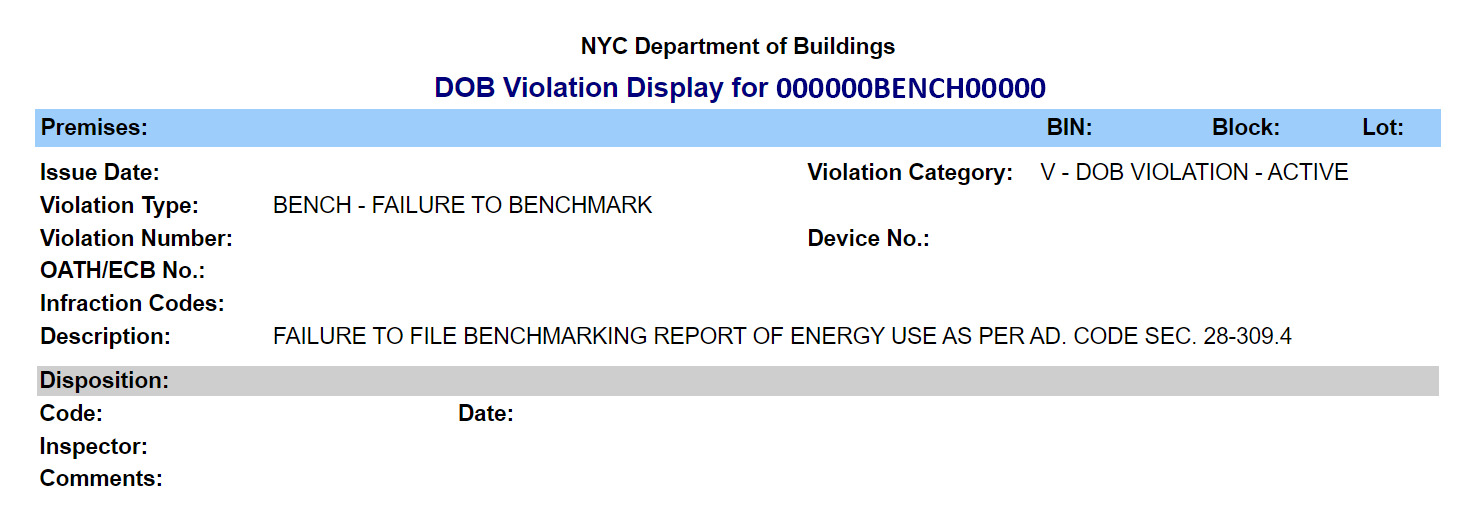
If the May 1 deadline is missed, subsequent quarterly compliance deadlines are August 1, November 1, and February 1 of the following year. Failure to submit required benchmarking data on time may result in additional violations and penalties.
The annual benchmarking compliance process generally includes the following steps:
Confirm Building Applicability
Check the current NYC Covered Buildings List (CBL) to determine whether your property is subject to annual benchmarking requirements.
Collect Energy and Water Data
Gather the building’s energy and water consumption data for the previous calendar year, along with required property information such as building use, gross floor area, and occupancy details.
Enter and Verify Data
Enter the required building and utility information into the U.S. EPA’s ENERGY STAR Portfolio Manager® and review the data for completeness and accuracy.
Submit Benchmarking Data
Submit the required benchmarking data to New York City by the applicable deadline. After submission, review the confirmation and check for any errors or deficiencies that may require correction and resubmission.
SFE manages the entire benchmarking process for building owners and property managers—from applicability review and utility data collection to Portfolio Manager setup, submission, and follow-up—helping ensure accurate and timely compliance.
| Deadline | Penalty |
| May 1 | $500 |
| August 1 | $500 |
| November 1 | $500 |
| February 1 (of the following year) | $500 |
| Maximum Annual Penalty | $2,000 |
Building owners need to report energy usage data, along with specific building information. For water use, benchmarking results will be uploaded by the Department of Environmental Protection for all buildings equipped by the DEP with automatic water meters for the full previous year.
Building owners can hire a representative and seek assistance from qualified professionals, such as energy consultants or engineers, who are experienced in Local Law 84 compliance. Additional resources and guidelines are available on the NYC.gov website.
In some cases, extensions may be available. Building owners should contact the relevant authorities to inquire about extension possibilities and requirements.
Local Laws 84, 87, and 97 work together to support NYC’s sustainability goals:
LL84 requires annual energy benchmarking, LL87 mandates energy audits and retro-commissioning every ten years, and LL97 sets carbon emissions caps—each playing a key role in reducing building energy use and emissions.
Mandates energy audits and retro-commissioning every ten years for buildings over 50,000 square feet, with penalties starting at $3,000 for late or incomplete filings.
Requires buildings over 25,000 square feet to limit carbon emissions under NYC’s climate goals, with annual reporting due each May and penalties starting at $268 per excess ton of CO₂.
© 2026 SFE. All Rights Reserved.